Showing posts with label school reform. Show all posts

Saturday, August 29, 2015

"A New World for the Teaching" - Belief Statements in the Des Moines Teacher Flash Mob

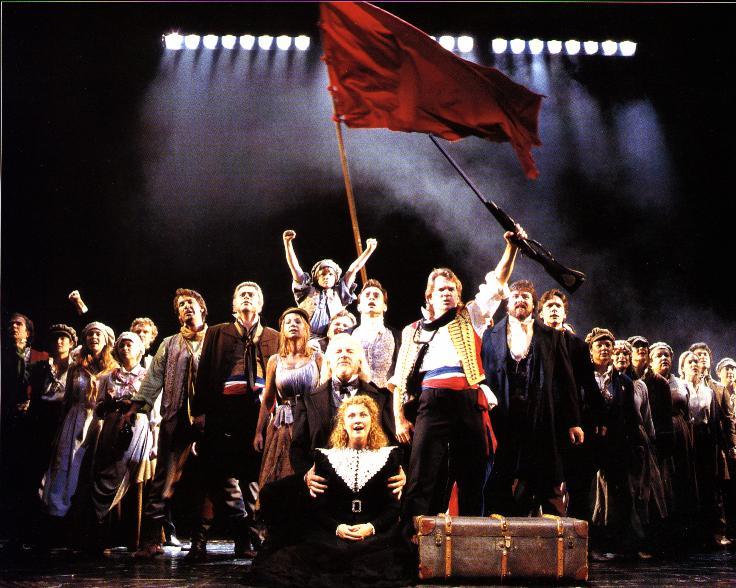
Have you seen the "Les Mis" flashmob video that has gone viral this week? Teachers in the Des Moines, Iowa school district broke into the final day of workshop week to perform a back-to-school version of One Day More. If not, take a minute to watch it, and scroll down on the YouTube page for the lyrics - as sung, they overlap so are hard to discern. 

It is well done, and even just looking at the surface level, and it speaks plenty of truth - these really are the thoughts that go through the heads of teachers I know, these are their cares and worries as they head into a new school year feeling like they have not and could never have enough time to truly be ready for the kids. Watch it once that way and have a good laugh. And then consider why it's funny - the idea of teachers being as committed to their beliefs as the French revolutionaries of Les Mis. Preposterous! In my work I see that teachers, as a group, are more willing to speak of their thoughts, feelings or actions than their beliefs - particularly white teachers who form the majority of our nation's teaching force. When educators do try to articulate beliefs, they are not often helped by their district's or school's mission statement - frequently just a lukewarm rehash of some platitudes about all children being ready for college and life, etc. Hardly something to spill blood over.

But, Is There More?

Looking underneath the seeming breeziness of this light parody and comparing it to the original, we can find a deeper truth. Hidden underneath the comic presentation are some underlying beliefs that fuel an actual controversy in education, something for which blood is indeed being spilt - though the casualties are often the students. 

In the play, One Day More is set on the eve of an uprising. The men with the flag are singing about their ideals and how the time has come for action - trying to recruit a young man who has been on the edge of their group. They are willing to risk their lives to end the inequities they see. In the play, most of them die. The parody lyrics of this group and their prospective recruit are: 
One more day before we start!  
                                 Do I join her for PD?  
Learning targets bring you freedom! 
                                 Shall I join their PLC?  
Common assessments shall be made. 
                                 Formative or summative?  
Will you come and plan with me?
So, the revolutionaries’ sleeper cell is now a PLC and their ideology is a very technical focus on learning targets and assessment literacy. Good ideas and ones that I’ve espoused in public before, but hardly something I’m willing to spill blood over. Hmm. Stay tuned for the deeper beliefs. 

Les Mis contrasts the revolutionaries with the aristocrats, older men who in the play fully believe that they will put down this nuisance of a revolution led by the younger generation. They dismissively call the revolutionaries “schoolboys,” and sing “they will wet themselves - with blood!” This group is clearly confident in themselves and their belief in the status quo. In the parody they sing:
One more day to education, 
We will help these students grow!
We'll be ready for these schoolboys,
We will teach what they don’t know!
To my mind, this actually is the sound of the education status quo - that mindset that students are empty vessels and we will just open up their heads and pour in what they don’t know. Notice who is in the position of power in this scenario. Like their counterparts in the play, these teachers believe their status is part of the natural order and don’t see anything wrong with their domination of the classroom. They come right out and say it. 

Comic Relief?

In the play the comic relief is a husband and wife who are essentially con artists, existing on the edges of society and bilking the unwitting, wealthy or poor. They survive no matter what turn the economy takes because there’s always someone to take advantage of, and they themselves don’t connect with either ideology. They are benevolently treated as kind of an inconvenient fact of life. In the parody, they appear to represent the early childhood teachers:
Watch 'em run around,
Catch 'em if they fall,
Making sure the classroom’s ready for them all!
Here’s a little crayon,
There’s a little glue,
Markers, pens, and pencils -
They know what to do!
Notice that the implied mindset of this group stands in opposition to that of the teacher aristocracy above. Rather than being empty vessels, these kids “know what to do.” The teacher’s job is to prepare a learning environment, allow children to be active and take chances, then act as the safety net - both intellectual and physical. Reggio, anyone? These teachers are the committed 
constructivists with a view of the child as competent - and notice that they are the comic reliefWhat’s going on in those rooms doesn’t seem very serious or connected to the common core, etc. I am reminded of the cartoon show, Recess, where the Kindergartners were portrayed as a tribe with rules of their own. (Of course the Recess depiction itself references both white society's appropriation and dismissal of indigenous ways, also not to be taken seriously in schools - but that's another post!) Furthermore, these early childhood teachers are so busy being and doing with their children that they don't always advocate well for their beliefs. I mean, just look at the woman in the picture, clearly an experiential teacher. Her high school AP and IB colleagues - the literal and figurative "upper class" of any school district - could learn a lot from her, but how many would take her seriously enough to listen? Or do they believe that this level of constructivism is essentially a long con?


Finally the Revolutionaries Spit It Out!

Next, the revolutionaries come back in with their underlying belief: 
There's a new world for the teaching! 
                              There's a new world to be taught!
OK, there's a subtle difference there between the revolutionary and the recruits - who is doing the teaching, the world or the teacher? The belief that is beginning to appear is truly revolutionary: the world is new and we as teachers must be responsive to it. We must understand that the students are already living in the new world and we need to meet them there. And this isn't always easy. This world is new in many ways that may be foreign to us - it constantly sprouts new technologies, is connected by social media, recognizes gender beyond a simple binary, and is full of the multiple perspectives of people of different colors. No one can know this whole world, or even the sum of the experiences of all the students in a single classroom - so we must turn the learning back over to them.

But then the old guard reiterates their position:
We’ll become these student’s heroes,
We will lead and they will go.
We will build them a bright future,
We know things that they don’t know!
Now they also have belied their underlying belief. The world isn’t new so much as there is a future to be built, by the teachers, for the students, using the teachers’ superior knowledge. For this to work, the students must follow the teachers as heroes. If we take this metaphor out to its logical end, we can’t then tolerate dissension in the ranks, and we will call it “insubordination,” because it is getting in the way not just of our teaching, but of all of their bright futures. 

So, What are the Patterns?

I want to be clear that these patterns show up across the country, not just in the particular district that produced this musical moment. But, as with all art, the composers may not be consciously aware of all the influences that they have channeled. As with education, the arts can be a provocation for social construction of knowledge. So here is what I see, through my critical lens as a white, female, Reggio-inspired educator: 
Those who believe in the heroic myth of the status quo do hold a beautiful vision of a bright future that must be built; but their deficit view of the child dictates a teacher-centric approach.  
The revolutionaries do sense that there’s a new world for the teaching but may or may not understand how to go about that.   
And, as in the original, the early childhood constructivists who don’t relish conflict go on surviving at the margins, keeping their heads down and ignoring the battle between the revolutionaries and the status quo. 
But, 
Imagine if we started the school year as true revolutionaries; 
Imagine a school where the mission statement was that inspiring; 
Imagine a district whose flag actually caused teachers to rally, to put an end to the inequities they see despite the highest of stakes. . . 

Friday, April 25, 2014

Common Ground on Common Principles: Reflections on Reggio & Essential Schools

Synergy: CES Common Principles & Reggio Key Principles
When I started teaching in an arts-centered, project-based school, I was addicted to that exhilarating "build the plane as you fly it" feeling. We all were. It was a grand experiment. And yet, we had the Coalition of Essential Schools (CES) 10 Common Principles to guide us in our planning, to tell us how but not what to teach. When our district curriculum people scrutinized our program, we could remind them that our mission was to emphasize depth over coverage. When parents questioned where our "honors" classes were, we could proudly state that our goals applied to all our students. At about the same time, my son began Kindergarten in a Reggio-inspired program and, out of curiosity, I volunteered to be on the curriculum committee. What I found as I immersed myself in the Reggio philosophy blew me away! Me finding the Reggio principles was like an arctic explorer discovering a cache of nutritious food - something to sustain and inspire me as I continued in the work of student-centered, emergent, project-based education. Reggio helped me connect the dots to understand why some of our CES principles worked, how they fit together, and how they might be leveraged for even greater civic good. For some time I have wanted to sort out the commonalities between what I think of as "little kid" (Reggio-Inspired) and "big kid" (CES) emergent learning. What I found in this project reminds me that, just as with all our students, what we're hungry to learn is what we're ready to synthesize.

Learning From What Is, and Isn't Clustered:
The diagram above is my visualization of the interplay between the 10 Common Principles of CES and the Key Principles of the Educational Project of Reggio Emilia, Italy (from Reggio Children's 2010 bookletIndications: Preschools and Infant-Toddler Centres of the Municipality of Reggio Emilia). Principles are italicized (Reggio) or not (CES) to show their origin. The commonalities of the two approaches are shown as clusters in the same petal of the flower, and written in the same color (I have continued these colors throughout the post so you don't have to keep scrolling back up). This is still a work in progress with some rough edges. For instance, neither CES nor Reggio Children cluster their principles into broader topics. The names I've chosen for some clusters above are a somewhat uneasy fit, e.g., Reggio educators don't really think about "Curriculum" in the way that has been instilled in US educators. Still, when I clustered like ideas from the two approaches there was a clear clump of the what and how of learning, so "Curriculum" was the closest English word for this petal. 

Documentation completely defies categorization. It permeates every category and supports each of the other principles. This concept can be one of the hardest ones for US teachers to really wrap their heads around, and now I see why: depending upon the context of your question about it, you could get a valid answer that makes you think it is really part of CurriculumCivic EngagementSchool LogisticsStudent-Teacher Relationships or View of the Child. And, really it is - the danger is in thinking that it is only related to one or two of them. Interestingly, there is no analogous principle in CES. Perhaps this is because older students are often the ones responsible for gathering their own work into reflective portfolios. Still, this misses the entire teacher/team reflection of Reggio-style documentation. One interesting development in the US is the Critical Friends Group (CFG) work that the National School Reform Faculty and others are doing. CFGs may start with data, but their questioning approach moves quickly into the personal beliefs, assumptions and actions of the presenting teacher, supported by other teachers as “critical friends.” It has transformative potential exactly because it encourages the kind of reflection on student work that occurs in Reggio-style teacher reflections on Documentation. CES has embraced this approach and included several sessions on its use at this year’s Fall Forum.  

There are a handful of principles that have roots in more than one cluster. For instance, when CES schools "Model democratic and equitable practices," they are both structuring their Logistics of school governance and inviting Civic Engagement. Similarly, requiring students to Demonstrate Mastery via Exhibition  is definitely a CES Curriculum mandate and, if adults outside the school community participate, also a powerful Civic Engagement tool. Even more subtly, the design of the learning Environment is part of the Curriculum - indeed, Reggio-inspired teachers I know invest a good deal of their time in preparing their environments - but it both requires and reinforces a view of the Child as Competent. If you close your eyes and imagine children in an environment that "fosters interaction, autonomy, explorations, curiosity and communication," you can't help but see Competent children, going about the business of Constructing learning as Protagonists of their education. 
Comparing Apples to Apples?
After first focusing in on the commonalities, I next zeroed in on the contrasts. I then realized I needed to shake up the familiarity of these phrases to get a sense of the overall nature of Reggio and CES principles - so I reframed each as a word cloud. In fact, as I took a deeper look at the actual language, I realized that CES' principles are generally much more concrete. More of the words in its cloud are adjectives delineating the processes of learning: personalized, democratic, demonstrated. Many of the principles can serve as goal statements for program evaluation: do you require Demonstration of mastery via exhibition, or not?  


Reggio Word Cloud


This is quite different from the bulk of the Reggio 
principles, more of which are abstract nouns: environment, interaction, protagonist - not to mention progettazione! The principles themselves tend to be more conceptual: Assessment as ongoing public dialogue and interpretation is more difficult to quantify than Demonstration of mastery, and is itself less goal-oriented. Even where Reggio principles are at their most concrete (Organization of work, space & time assumes shared responsibility) CES takes one step further into the "how" of it (Develop budgets & student loads that support the principles). Sometimes, an abstract Reggio principle implies the concrete CES ones. Within Student-Teacher Relationship, Reggio's notion of a Pedagogy of Listening can include all of the CES specifics: Personalized Learning, Teacher as Coach, and Tone of Decency,Trust and Unanxious Expectation.

It's no surprise that the more concrete principles arose in response to the US educational system, where school leaders needed to be able to parse their philosophies in concrete terms. What’s more, CES got its start in high schools - where, for example, that Tone of Decency, Trust and Unanxious Expectation had often been abandoned - so they spelled it out for us. By contrast, in most US early childhood programs there is at least an awareness that children are developing social skills, and that modeling of decency, trustworthiness and respect are necessary.

Iceberg Model 
Perhaps the reason that the concrete of CES can be implied in the abstract of Reggio can be explained by Stanley Herman's Cultural Iceberg model. The Reggio principles are the why of the matter, the values underpinning the visible iceberg of the school, the “if . . .” to the CES “then . . .”  If you see children as competent protagonists of their own learning, then your goals will apply to all. If you value shared inquiry across 100 languages in carefully prepared environments, then you'll end up with depth over coverage and students learning to use their minds well; what's more you'll have opportunities to see students demonstrating mastery. If you assume shared responsibility, then your teachers are going to have to be generalists. Try it yourself: say "If," and then read any italicized statement in the diagram; then say "then" and read any regular statement in the same color, and see where that thought experiment takes you. 

This is why the two methods complement each other so well. The Reggio philosophy conceptually articulates a set of values within which professionals, parents and children define their own work. These principles testify to a system that has continued to refine itself over more than half a century. It takes time. By contrast, CES is just celebrating its 25th anniversary - still quite a milestone in the consumer culture of US secondary education where reforms are often discarded long before they have a chance to take root. CES' principles walk the tightrope of defining the common work to jump-start the logistics of the reforms, but not prescribing a cookie-cutter product. 

And, after 25 years, perhaps the time has come for us all to articulate the values that underpin our observable structures. After all, our goals, technologies and structures can all be imposed from above; our beliefs can be questioned; but our values are our own. In reality, our values have always mattered deeply to us, but, as members of a culture that values all those overt things that top the iceberg, we have not taken the time to articulate the covert underpinnings. Fortunately, the educators of Reggio Emilia have.

Wednesday, October 30, 2013

Mining to Farming: A Paradigm Shift to Close the Gaps

I once attended a workshop with Dr. Pedro Noguera, during which the noted education author and NYU professor of Sociology joked that he still didn't quite have the teaching metaphor that we could all relate to. He tried some sports ones, then moved into gardening, still not quite fully embodying his ideas. I'd like to offer an image used by my former Blake School colleague, Rand Harrington: moving from "mining" to "farming." Rand used this to describe the difference between the hiring process and the staff development process. Hiring is much like mining - you delve into a mountain of resumes, tossing aside anything that's not the element you're looking for. Hopefully you end up with a gem of a teacher. But in the staff development process, you become more like a farmer - watering, feeding, weeding, sometimes pruning, and generally doing what you can to help him or her grow. 


This metaphor seems even more fit to the paradigm shift that must happen in teaching if we are truly to reform an education system that was formulated to create and sustain inequity. After all, wouldn't you call a system in which the goal was to sort and measure, in which the products that don't measure up are discarded, and in which the most resources are allocated to the most productive vein a "mining" system? And isn't a system in which the goal is cultivation to maximize future productivity, and in which resources are allocated according to need more like "farming?" To take the metaphor even further, I believe we need to develop a sustainable farm of education, one that knows that it is part of an ecological community and leverages the relationships within it - as opposed to a monoculture that must apply ever more toxic substances to ensure a harvest of identical and travel-tough, if bland, crops. 

Clues from Language, Links to Mindset
Let's take a look at language that teachers use to see if we can discern the dominant metaphor of their system. Often in conservatory style programs there are discussions about "stealing" students from other programs, leading staff members to "guard" their rosters. Students with latent talent are "diamonds in the rough" who just need "a little polish." All of this implies a mining system where there is ownership of a scarce resource; 
underlying this is a talent mindset - a belief that intelligence and talent are fixed quantities

Mindsets Book Front CoverStanford researcher Dr.Carol Dweck has described this as a "fixed intelligencemindset. By contrast, her research shows that all the intelligences are able to grow via training and practice. I'm reminded of Kennedy Center Arts Consultant Deb Brzoska's comment, "Show me a 5th grader with 'talent' and I'll show you a 5th grader with private lessons." This became a guiding principle of the admissions process at Vancouver School of Arts and Academics (VSAA). Rather than skill, we looked for passion and excitement about the arts. We knew that where there was a will to grow on the part of the student, we as a staff could cultivate that growth. 

Brzoska, who was the founding principal of VSAA, understood the power of language to direct mindset. She actually fined staff for using the term "My" in relationship to the school. We had a "My-jar" into which we had to place a quarter any time we referred to "My students," "My program," etc. They were "Our" students, and time that our shared students spent in another teacher's class was understood to contribute to their "Growth." All classes in any discipline were referred to "Skills" classes, where students could "Develop" artistic or academic competencies. All of these imply a farming system, undergirded by the growth mindset. This, according to Dweck, is necessary for the development of talent and intelligence.  

But What About the Gap?
What Dr. Noguera was trying to metaphorically describe in his workshop (as well as his bookwas a way of teaching that could ameliorate the gaps we currently see.

Yes, gaps, plural. Noguera and co-author A.Wade Boykin brilliantly split the achievement gap into several component gaps so that we can understand some of its complexity. Once the parts are untangled, it is easier to understand how to address each one - and easier to see how many well-intentioned reforms that target one dimension may derail another. Think of them each as a former mine site that needs to be replanted and carefully restored into a balanced ecosystem.These sub-gaps include: 
  • the Preparation Gap 
  • the Opportunity Gap 
  • the Discipline Gap 
  • the Parent-School Gap
  • the Ability-Performance Gap

For now, let's focus on just one: the Ability-Performance Gap, defined as that place from which students check out. Noguera suggests that to combat this we must make learning more active and relevant. In the schools at which I've had the privilege to work, Arts Integration is the strategy we've adopted for this. And it works. We may have drama, but not boredom. We may have teen anxt, but it's meaningful. We may have what looks like chaos, but it's creative chaos and if you look for it, you'll see both the structure undergirding it and the learning students are constructing within it.


Still, there are arts programs that are vibrantly active and clearly relevant to the few, selected (read: Mined) students within them. Here's where promoting closure of one gap can magnify another. These programs may eliminate any Ability-Performance Gap, but open an Opportunity Gap for students whose "talent" is not obvious at the outset.

Even in programs that eschew the conservatory approach in favor of skill development, hence bypassing the Opportunity Gap, there is a corner of the White, Western-European arts culture that can unwittingly contribute to the Ability-Performance Gap. We often have rules, explicit or unwritten, against "poaching" students from our colleagues' programs. These may not be a holdover from the conservatory paradigm, but rather a nod to diminishing FTE in the arts as well as sensitivity to students' crowded schedules. The gist is that teachers are not allowed to recruit students from others' classes or programs. Sometimes this gets generalized to include encouragement to continue the study of a discipline. I once moderated a heated discussion at a school over one teacher's written comment along the lines of, "I hope to see you in Level 2 next year." While it is unhealthy for kids to be placed in a tug-of-war between teachers, there's a big difference between that and encouragement. That difference is a focus on the student, rather than the program or the teacher. Many successful adults tell stories of that teacher who saw their development and encouraged them to keep on, often just when they were doubting themselves. We owe it to kids to do the same - and then to step back and let them decide how and when to act on our encouragement and possibly that of others. Isn't this just farming at its best? Applying a touch of fertilizer, watering a curious root, pulling a weed of self-doubt? (And don't get me started on heaping up the manure of false praise to keep a student in your program . . . it only burns them in the end). 

As we encourage our students to continue in the active programs they find relevant, we'll be helping to close the Ability-Performance Gap.